UFO'S
(If you have had any experiences of UFO's USO's or alien contact please do so by contacting ue, either by following the link to our contact us page or by emailing us here at udb@mail.com)
The Crash Near Roswell
An unidentified flying object crashed on a ranch northwest of Roswell, New Mexico, sometime during the first week of July 1947.
 Rancher
W.W. “Mack” Brazel said later he found debris from the crash as he and
the son of Floyd and Loretta Proctor rode their horses out to check on
sheep after a fierce thunderstorm the night before. Brazel said that as
they rode along, he began to notice unusual pieces of what seemed to be
metal debris scattered over a large area. Upon further inspection, he
said, he saw a shallow trench several hundred feet long had been gouged
into the ground.
Rancher
W.W. “Mack” Brazel said later he found debris from the crash as he and
the son of Floyd and Loretta Proctor rode their horses out to check on
sheep after a fierce thunderstorm the night before. Brazel said that as
they rode along, he began to notice unusual pieces of what seemed to be
metal debris scattered over a large area. Upon further inspection, he
said, he saw a shallow trench several hundred feet long had been gouged
into the ground.
Brazel said he was struck by the unusual properties of the debris
and, after dragging large pieces of it to a shed, he took some of it
over to show the Proctors.
Mrs. Proctor, who later moved from the ranch to a house closer to
town, said she remembers Brazel showing up with the strange material.
The Proctors told Brazel he might be holding wreckage from an
alien spacecraft — a number of UFO sightings had been reported in the
United States that summer — or a government project, and that he should
report the incident to Chaves County Sheriff George Wilcox.
 A
day or two later, Brazel drove into Roswell, the county seat, and
reported the incident to Wilcox, who reported it to Maj. Jesse Marcel,
intelligence officer for the 509th Bomb Group, stationed at Roswell Army
Air Field.
A
day or two later, Brazel drove into Roswell, the county seat, and
reported the incident to Wilcox, who reported it to Maj. Jesse Marcel,
intelligence officer for the 509th Bomb Group, stationed at Roswell Army
Air Field.
In their book, A History of UFO Crashes, UFO researchers Don
Schmitt and Kevin Randle say their research shows military radar had
been tracking an unidentified flying object in the skies over southern
New Mexico for four days. On the night of July 4, 1947, radar indicated
the object had gone down about 30-40 miles northwest of Roswell.
The book says eyewitness William Woody, who lived east of Roswell,
said he remembered being outside with his father the night of July 4,
1947, when he saw a brilliant object plunge to the ground.
The debris site was closed for several days while the wreckage was
cleared, and Schmitt and Randle say that when Woody and his father
tried to locate the area of the crash they had seen, Woody said they
were stopped by military personnel who ordered them out of the area.
Debris
 Schmitt
and Randle say Marcel, after receiving the call from Wilcox and
subsequent orders from Col. William Blanchard, 509th commanding officer,
went to investigate Brazel’s report. Marcel and Capt. Sheridan Cavitt,
senior Counter Intelligence Corps (CIC) agent, followed the rancher
off-road to his place. They spent the night there and Marcel inspected a
large piece of debris Brazel had dragged from the pasture.
Schmitt
and Randle say Marcel, after receiving the call from Wilcox and
subsequent orders from Col. William Blanchard, 509th commanding officer,
went to investigate Brazel’s report. Marcel and Capt. Sheridan Cavitt,
senior Counter Intelligence Corps (CIC) agent, followed the rancher
off-road to his place. They spent the night there and Marcel inspected a
large piece of debris Brazel had dragged from the pasture.
Monday morning, July 7, Marcel took his first step onto the debris
field. Marcel would remark later that “something ... must have exploded
above the ground and fell.” As Brazel, Cavitt and Marcel inspected the
field, Marcel was able to “determine which direction it came from, and
which direction it was heading. It was in the pattern ... you could tell
where it started out and where it ended by how it was thinned out …”
According to Marcel, the debris was “strewn over a wide area, I guess
maybe three-quarters of a mile long and a few hundred feet wide.”
Scattered in the debris were small bits of metal that Marcel held a
cigarette lighter to to see if it would burn.
Along with the metal, Marcel described weightless “I”-beam-like
structures that were three-eights inch by one-quarter inch, none of them
very long, that would neither bend nor break. Some of these “I”-beams
had indecipherable characters along the length, in two colors. Marcel
also described metal debris the thickness of tinfoil that was
indestructible.
After gathering enough debris to fill his staff car, Marcel decided to
stop by his home on the way back to the base so he could show his
family the unusual debris. He’d never seen anything quite like it.
“I didn't know what we were picking up,” he said. “I still don't know
what it was ... It could not have been part of an aircraft, not part of
any kind of weather balloon or experimental balloon ... I’ve seen
rockets ... sent up at the White Sands Testing Grounds. It definitely
was not part of an aircraft or missile or rocket.”
Under hypnosis conducted by Dr. John Watkins in May 1990, Jesse Marcel
Jr. remembered being awakened by his father that night and following
him outside to help carry in a large box filled with debris. Once
inside, they emptied the contents of the debris onto the kitchen floor.
Jesse Jr. described the lead foil and “I”-beams. Under hypnosis, he
recalled the writing on the “I”-beams as “Purple. Strange. Never saw
anything like it ... different geometric shapes, leaves and circles.”
Under questioning, he said the symbols were shiny purple and they were
small. There were many separate figures. This too, under hypnosis:
[Marcel Sr. was saying it was a flying saucer] “I ask him what a flying
saucer is. I don't know what a flying saucer is ... It’s a ship. [Dad’s]
excited!”
Marcel reported what he found to Blanchard, showing him pieces of the
wreckage, none of which looked like anything Blanchard had ever seen.
Bodies
Meanwhile, Glenn Dennis, a young mortician working at Ballard
Funeral Home, received some curious calls one afternoon from the RAAF
morgue. The base’s mortuary officer was trying to get hold of some
small, hermetically sealed coffins and also wanted to know how to
preserve bodies that had been exposed to the elements for a few days and
avoid contaminating the tissue.
Dennis later said that evening he drove to the base hospital,
where he saw large pieces of wreckage with strange engravings on one of
the pieces sticking out of the back of a military ambulance. He entered
the hospital and was visiting with a nurse he knew when suddenly he was
threatened by military police and forced to leave.
The next day, Dennis met with the nurse, who told him about bodies
discovered with the wreckage and drew pictures of them on a prescription
pad. Within a few days she was transferred to England; her whereabouts
remain unknown.
Roswell Army Air Field Press Release
 At
11 a.m., July 8, 1947, Lt. Walter Haut, RAAF public information
officer, finished a press release Blanchard had ordered him to write,
stating that the wreckage of a crashed disk had been recovered.
At
11 a.m., July 8, 1947, Lt. Walter Haut, RAAF public information
officer, finished a press release Blanchard had ordered him to write,
stating that the wreckage of a crashed disk had been recovered.
 He gave copies to the two radio stations and both of the local
newspapers. By 2:26 p.m., the story was on The Associated Press wire:
He gave copies to the two radio stations and both of the local
newspapers. By 2:26 p.m., the story was on The Associated Press wire:
“The Army Air Forces here today announced a flying disk had been found.”
As calls began to pour into the base from all over the world, Lt.
Robert Shirkey watched as MPs carried loaded wreckage onto a C-54 from
the First Transport Unit.
To get a better look, Shirkey stepped around Col. Blanchard, who was
irritated with all of the calls coming into the base. Blanchard decided
to travel out to the debris field and left instructions that he'd gone
on leave.
Headquarters Gets Involved
Blanchard had sent Marcel to Fort Worth Army Air Field (later
Carswell Air Force Base) to report to Brig. Gen. Roger M. Ramey,
commanding officer of the 8th Air Force.
 Marcel
told Haut years later that he’d taken some of the debris into Ramey's
office to show him what had been found. The material was displayed on
Ramey's desk for the general when he returned.
Marcel
told Haut years later that he’d taken some of the debris into Ramey's
office to show him what had been found. The material was displayed on
Ramey's desk for the general when he returned.
Upon his return, Ramey wanted to see the exact location of the
debris field, so he and Marcel went to the map room down the hall — but
when they returned, the wreckage that had been placed on the desk was
gone and a weather balloon was spread out on the floor. Maj. Charles A.
Cashon took the now-famous photo of Marcel with the weather balloon in
Ramey's office.
It was then reported that Ramey recognized the remains as part of a
weather balloon. Brig. Gen. Thomas DuBose, the chief of staff of the
8th Air Force, said, “[It] was a cover story. The whole balloon part of
it. That was the part of the story we were told to give to the public
and news and that was it.”
 Later that afternoon, Haut’s original press release was rescinded
and an officer from the base retrieved all of the copies from the radio
stations and newspaper offices. The next day, July 9, a second press
release was issued stating that the 509th Bomb Group had mistakenly
identified a weather balloon as wreckage of a flying saucer.
Later that afternoon, Haut’s original press release was rescinded
and an officer from the base retrieved all of the copies from the radio
stations and newspaper offices. The next day, July 9, a second press
release was issued stating that the 509th Bomb Group had mistakenly
identified a weather balloon as wreckage of a flying saucer.
On July 9, as reports went out that the crashed object was
actually a weather balloon, cleanup crews were busily clearing the
debris. Bud Payne, a rancher at Corona, was trying to round up a stray
when he was spotted by the military and carried off the Foster ranch.
Broadcaster Judd Roberts and Walt Whitmore were turned away as they
approached the debris field.
As the wreckage was brought to the base, it was crated and stored in a hangar.
 Back in town, Walt Whitmore and Lyman Strickland saw their friend,
Mack Brazel, who was being escorted to the Roswell Daily Record by
three military officers. He ignored Whitmore and Strickland, which was
not at all like Mack, and once he got to the Roswell Daily Record
offices, he changed his story. He now claimed to have found the debris
on June 14. Brazel also mentioned that he’d found weather observation
devices on two other occasions, but what he found this time was no
weather balloon.
Back in town, Walt Whitmore and Lyman Strickland saw their friend,
Mack Brazel, who was being escorted to the Roswell Daily Record by
three military officers. He ignored Whitmore and Strickland, which was
not at all like Mack, and once he got to the Roswell Daily Record
offices, he changed his story. He now claimed to have found the debris
on June 14. Brazel also mentioned that he’d found weather observation
devices on two other occasions, but what he found this time was no
weather balloon.
The Las Vegas Review Journal, along with dozens of other newspapers, carried the AP story:
“Reports of flying saucers whizzing through the sky fell off
sharply today as the Army and the Navy began a concentrated campaign to
stop the rumors.”
The story also reported that AAF Headquarters in Washington had “delivered a blistering rebuke to officers at Roswell.”
The military has tried to convince the news media from that day
forward that the object found near Roswell was nothing more than a
weather balloon.
THE RENDLESHAM FOREST LANDINGS
One of the most compelling accounts of UFO landings comes to us from England. The joint air bases of Bentwaters and Woodbridge, located within the vast Rendlesham Forest, would be literally invaded by unidentified flying objects over a period of several nights in late December, 1980.
The amazing accounts of the twin air bases would be replete with descriptions of Alien beings, anomalous radar readings, electromagnetic effects, and surreal atmospheric conditions. Still investigated by Ufologists today, the almost unbelievable eyewitness accounts by credible professionals make the events of Bentwaters and Woodbridge Air Force Bases a cornerstone of belief among many UFO proponents.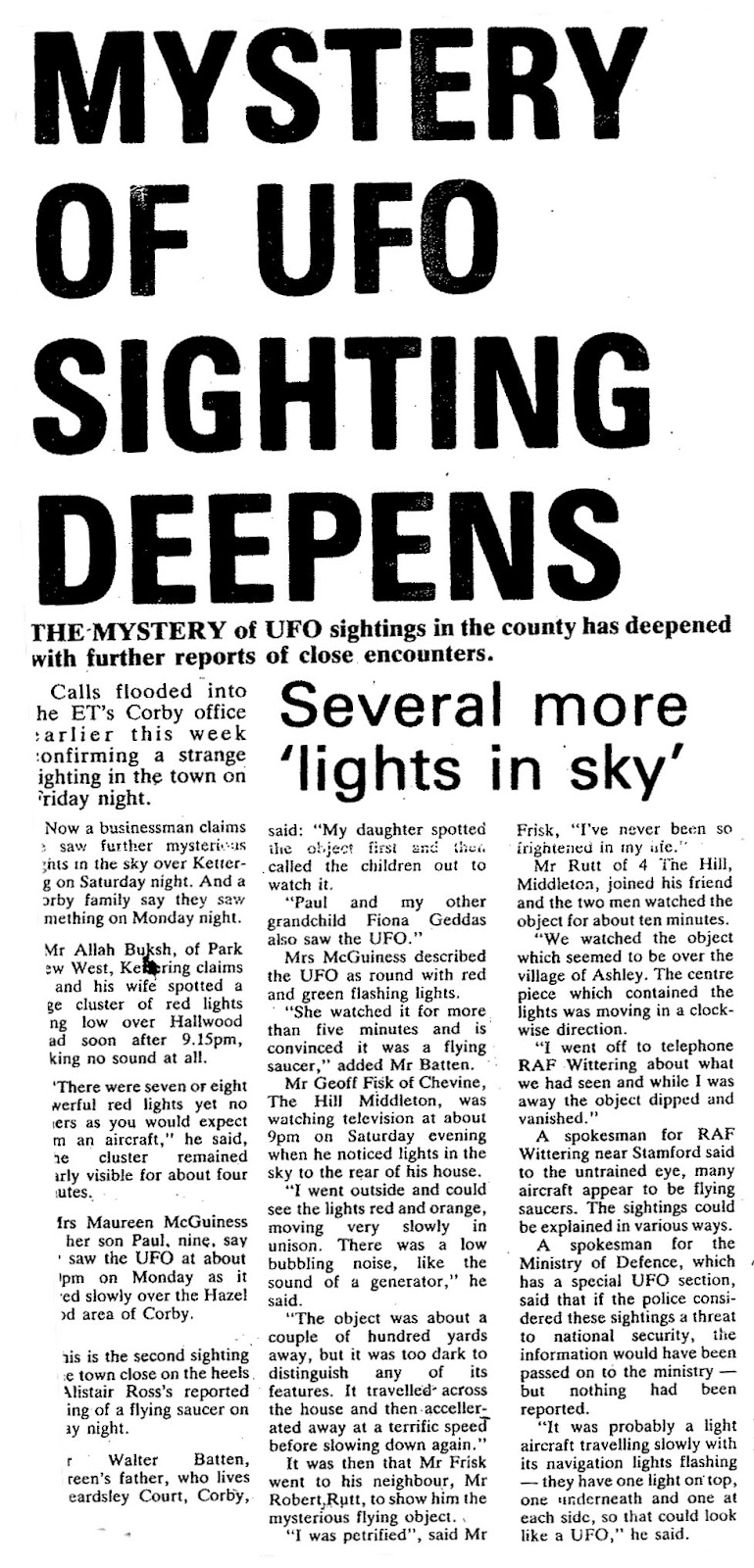
Shortly after midnight on December 27, 1980, radar screens at RAF Watton in Norfolk showed an uncorrelated object which suddenly disappeared in the vicinity of the Rendlesham Forest in Suffolk. The object was also tracked on radar at Bentwaters RAF, which was located north of the forest. Woodbridge was south of the forest.
The bases were reported to have a large stockpile of nuclear weapons, and Woodbridge was the home of the 67th Aerospace Rescue and Recovery Squadron. The unit was subject only to the Department of Defense in Washington, D.C. The sister bases were leased to the United States Air Force.
Mal Scurrah, radar operator that night, stated:
"We didn't have the faintest idea what it was. We checked through the air traffic agencies. There should have been nothing in that area at the time. The only thing we could do was send a jet aircraft in to find out what it was. They got to within about a quarter of a mile and the pilot suddenly started reporting that they could see a very bright light in the sky in front of them.
It was stationary on the screen and then, in seconds, it moved off at a fantastic rate of speed. Within the space of five minutes, it was reaching 90,000 feet and higher and we lost it off the top end of the radar scope. There's nothing we have in this day that can perform those kind of maneuvers, the pilots wouldn't be able to take it."
The extraordinary events of Woodbridge/Bentwaters would begin with the sighting of a gigantic glowing object by three security guards patrolling the twin bases. Receiving permission to check out the strange sightings, they followed the lights into the forest. Their initial interpretation was that a military or commercial aircraft had made a crash landing.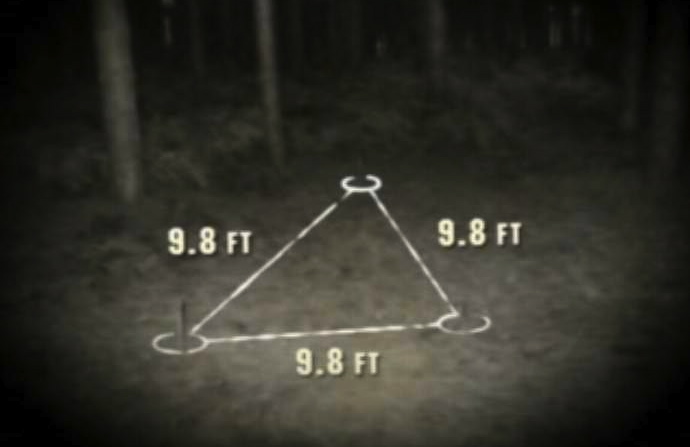
The patrol was shocked and frightened to see a saucer-like craft with small, large-headed beings, which seemed to be suspended from the bottom of the craft by a type of beam. The beings appeared to be busy, possibly affecting some type of repair to their craft. The beings seemed at first to be unaware of the three men watching their activities.
The guards, maintaining a safe distance from the craft and beings, were almost transfixed by the activities at the glowing object. They radioed to the base headquarters, reported what they were seeing, and requested emergency help.
Almost immediately assistance arrived, with a fully equipped armed unit, which included senior officers of the base. Later, there would be reports, off the record, that witnesses who ventured closest to the craft encountered strange anomalies. Among these were "reality bending" effects, like time displacement, and surreal atmospheric conditions.
Also, there were allegations that some of the senior officers were able to communicate with strange, alien beings, which floated in bubbles around a triangular-shaped craft. The craft was said to have appeared from a type of low-lying cloud. ("Left At East Gate") I must state that neither of these facts has been established officially.
Colonel Halt, called out on the second night of the sightings, was one of a group of senior officers to chase the eerie, glowing object into the forest. He would become a key figure in the Rendlesham investigation. He made a cassette of the details of his trek into the woods, and a transcription is given later in this article.
Also a copy of the memorandum Halt sent to the British Ministry of Defense is included.
Some of the most revealing details of the events of Rendlesham would be given by patrolmen Jim Penniston, John Burroughs, and Larry Warren, who would later co-write a book on the incident, "Left at East Gate."
Halt was a career Air Force officer, serving in Vietnam and on various bases before arriving at Bentwaters in 1980. He was promoted to base commander in 1984. Halt later served as base commander at Kunsan Air Base, Korea, and was director of the inspections directorate for the Department of Defense inspector general. He retired in 1991.
Though Halt was forthcoming with his accounts of Rendlesham, his life was complicated by constant demands by UFO investigators for more information on the Rendlesham events.
There were many stories told by the men who were present on the nights of the strange events at Rendlesham. One of the most remarkable concerned an underground theater where soldiers were interrogated, debriefed, sworn to secrecy, and threatened.
The morning after the most pronounced activity, a type of men-in-black scenario had occurred.
Several of the men were whisked away by the official-looking gentlemen, and escorted to the underground facility. Oddly enough, they were shown a number of motion picture films of different UFO recoveries around the world. It was also said that an Alien being was present at one of the meetings.
The spectacular events of late 1980 were kept out of the public knowledge for the most part, at least until 1983. An early UFO magazine article about the events brought only a passing interest, yet the story survived on rumor and speculation until Robert Todd of the Citizens Against UFO Secrecy (CAUS) secured a copy of an official report of the events through the Freedom of Information Act in 1983. The paper was dated 1-13-81, and had been sent to the British Ministry of Defense by Halt.
The events of Rendlesham have been published in numerous newspapers, magazine articles, and several television shows, including "Unsolved Mysteries," "Sightings," and the British program "Strange But True," among others.
The case, in some respects, is similar to the famous Roswell, New Mexico incident in that its investigation involved almost exclusively military personnel. Though the two incidents occurred in totally different countries, both involved United States manned installations, and were close to top secret military bases.
