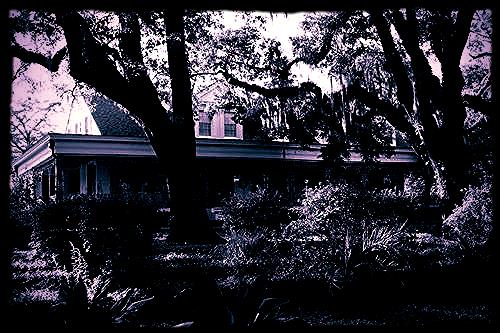
We have all seen the countless paranormal shows on TV, and whether or not you are a fan, there is no denying that advances are being made technologically with regards to the capture of evidence. Some people have speculated that it is only a matter of time before irrefutable proof is collected as to the existence of 'ghosts', 'spirits', 'apparitions', (whatever you want to call them). But long before all of this technological advancement, people were reporting their experiences of the supernatural. Here are just a few of their reports for you to get your teeth into! (If you have any stories that you would like to be included please do not hesitate to contact us.)
Scroll down for more haunting information on:
- The Villisca Axe Murder House
- The Winchester Mystery House
- The Ancient Ram Inn
- The Whaley House
|
- Raynham Hall
- The Myrtles Plantation
- Eastern State Penitentiary
- The Tower of London
- Waverly Hills Sanitorium
|

Borley Rectory was constructed near Borley Church by the Reverend Henry Dawson Ellis Bull in 1862 , he moved in a year after being named rector of the parish. The house replaced an earlier rectory on the site that had been destroyed by fire in 1841. It was eventually enlarged by the addition of a wing to house Bull's family of fourteen children.
The nearby church dates from the 12th century and serves a scattered
rural community of the three hamlets that make up the parish. There are
several substantial farmhouses and the fragmentary remains of Borley
Hall, once the seat of the Waldegrave family. Ghost-hunters like to
quote the legend of a Benedictine monastery
supposedly built in this area in about 1362, according to which a monk
from the monastery carried on a relationship with a nun from a nearby
convent. After their affair was discovered, the monk was executed and
the nun bricked up alive in the convent walls. It was confirmed in 1938
that this legend had no historical basis and seemed to have been
fabricated by the rector's children to romanticise their Gothic-style
red-brick rectory. The story of the walling-up of the nun may have come
from Rider Haggard's novel Montezuma's Daughter (1893) or Walter Scott's epic poem 'Marmion (1808). Until the newspaper stories about the ghosts, there had been no mention in the local papers, or any other written source, of any unusual happenings at the rectory. 
Hauntings
The first recorded paranormal
events apparently occurred in about 1863, since a few locals later
remembered hearing unexplained footsteps within the house at about this
time. On 28 July 1900, four of the daughters of the rector, Henry Dawson
Ellis Bull, reported seeing what they thought was the ghost of a nun at
twilight, about 40 yards from the house; they tried to talk to it, but
it disappeared as they got closer.
The local organist recalled that the family at the rectory were "very
convinced that they had seen an apparition on several occasions".Various people were to claim to have witnessed a variety of puzzling incidents, such as a phantom coach driven by two headless horsemen, during the next four decades. Henry Dawson Ellis Bull died in 1892 and his son, the Reverend Harry Bull, took over the living.
On 9 June 1928, Henry Foyster Bull, the rector, died and the rectory again became vacant. In the following year, on 2 October,
the Reverend Guy Eric Smith and his wife moved into the home. Soon
after moving in, Mrs Smith, while cleaning out a cupboard, came across a
brown paper package inside which was the skull of a young woman.
Shortly after, the family reported a variety of incidents including the
sounds of servant bells ringing despite their being disconnected,
lights appearing in windows and unexplained footsteps. In addition, Mrs
Smith believed she saw a horse-drawn carriage at night. The Smiths contacted the Daily Mirror asking to be put in touch with the Society for Psychical Research. On
10 June 1929, the newspaper sent a reporter, who promptly wrote the
first in a series of articles detailing the mysteries of Borley. The
paper also arranged for Harry Price, a paranormal researcher, to make his first visit to the house that would ultimately make him famous. He arrived on 12 June
and immediately objective "phenomena" of a new kind appeared, such as
the throwing of stones, a vase and other objects. "Spirit messages" were
tapped out from the frame of a mirror. As soon as Harry Price left,
these ceased. Mrs Smith later maintained that she already suspected
Harry Price, an expert conjurer, of causing the phenomena.
Alleged sighting in the grounds of Borley Rectory
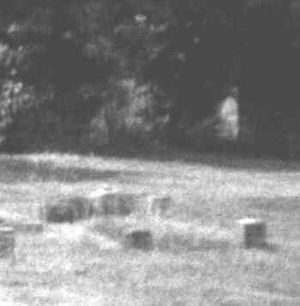
The Smiths left Borley on 14 July 1929 and the parish had some
difficulty in finding a replacement. The next year, the Reverend Lionel
Algernon Foyster (1878-1945), a first cousin of the Bulls, and his wife
Marianne (née Marianne Emily Rebecca Shaw) (1899-1992) moved into the
rectory with their adopted daughter Adelaide, on 16 October 1930.
Lionel Foyster wrote an account of various strange incidents that
happened, which he sent to Harry Price. Price estimated that, between
when the Foysters moved in and October 1935, many incidents took place
there, including bell-ringing, windows shattering, stones and bottle
throwing, wall-writing, and their daughter being locked in a room with
no key. Marianne Foyster reported to her husband a whole range of poltergeist phenomena that included her being thrown from her bed. On one occasion, Adelaide was attacked by "something horrible". Foyster tried twice to conduct an exorcism,
but his efforts were fruitless; in the middle of the first exorcism, he
was struck in the shoulder by a fist-size stone. Because of the
publicity in the Daily Mirror, these incidents attracted the attention of several psychic researchers,
who after investigation were unanimous in suspecting that they were
caused, consciously or unconsciously, by Marianne Foyster. Mrs Foyster
later stated that she felt that some of the incidents were caused by her
husband in collaboration with one of the psychic researchers, but other
events appeared to her to be genuine paranormal phenomena. Marianne
later admitted that she was having a sexual relationship with the lodger, Frank Peerless,and that she used "paranormal" explanations to cover up her liaisons.The Foysters left Borley in October 1935 as a result of Lionel's ill health.
Price investigation
Borley remained vacant for some time after the Foysters' departure,
until in May 1937 Price took out a year-long rental agreement with Queen Anne's Bounty, the owners of the property.
Through an advertisement in The Times on 25 May 1937
and subsequent personal interviews, Price recruited a corps of 48
"official observers", mostly students, who spent periods, mainly during
weekends, at the rectory with instructions to report any phenomena that
occurred. In March 1938 Helen Glanville (the daughter of S. J.
Glanville, one of Price's helpers) conducted a planchette seance in Streatham in south London.
Price reported that she made contact with two spirits, the first of
which was that of a young nun who identified herself as Marie Lairre.
According to the planchette story Marie was a French nun who left her
religious order and travelled to England to marry a member of the
Waldegrave family, the owners of Borley's 17th-century manor house,
Borley Hall. She was said to have been murdered in an earlier building
on the site of the rectory and her body either buried in the cellar or
thrown into a disused well.The wall writings were alleged to be her pleas for help; one read "Marianne, please help me get out"
The second spirit to be contacted identified himself as "Sunex Amures", and claimed that he would set fire to the rectory at nine o'clock that night, 27 March 1938. He also said that, at that time, the bones of a murdered person would be revealed.
Destroyed by fire
On 27 February 1939 the new owner of the rectory, Captain W. H. Gregson, was unpacking boxes and accidentally knocked over an oil lamp in the hallway.
The fire quickly spread and the house was severely damaged. After
investigating the cause of the blaze the insurance company concluded
that the fire had been started deliberately.
Miss Williams of Borley Lodge said she saw the figure of the ghostly
nun in the upstairs window and, according to Harry Price, demanded a fee
of one guinea for her story.In August 1943 Harry Price conducted a brief dig in the cellars of the
ruined house and discovered two bones thought to be of a young woman.The bones were given a Christian burial in Liston churchyard
THE VILLISCA AXE MURDER HOUSE 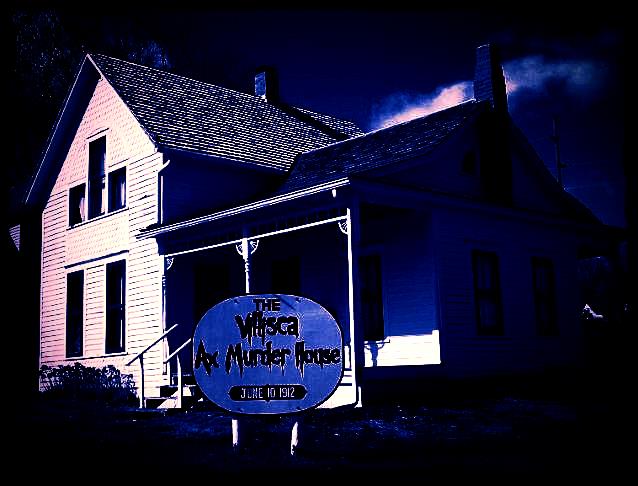
On a quiet residential street in this small town sits an old white frame
house. On a dark evening, the absence of lights and sounds are the
first indication to visitors that this house is different from the other
homes that surround it. Upon closer inspection, you'll notice her
doors and windows are tightly closed and covered. An outhouse in the
backyard suggests that this house does not occupy a place in the 21st
century but somehow belongs in another era or another story. A
weather-beaten sign warns rather than welcomes. This is the "Murder
House".
Almost 97 years ago, long before serial killers and mass murders
had become a way of life, two adults and 6 children were found brutally
murdered in their beds in the small mid-western town of Villisca, Iowa.
During the weeks that followed, life in this small town changed
drastically.
As residents of this small town reinforced locks, openly carried
weapons and huddled together while sleeping, newspaper reporters and
private detectives flooded the streets. Accusations, rumors and
suspicion ran rampant among friends and families. Bloodhounds were
brought in. Law enforcement agencies from neighboring counties and
states joined forces. Hundreds of interviews filled thousands of
pages.
And yet, the murders remained unsolved, the murderer unpunished.

In 1994, Darwin and Martha Linn of Corning, Iowa purchased the
former home of murder victim J.B. Moore and his family. The house was
returned to it's original condition at the time of the murders on June
10th, 1912. It was listed on the National Registrar of Historic Places
and opened for tours.
Films and books on the murders have recently captured the interest
of an audience who had never heard of this horrendous crime. Psychics
claim they've identified the murderer and history buffs continue
collecting piles of documents they say point to the truth.
In all honesty though, we will never really know what happened on
that dark night inside the home of J.B. and Sarah Moore. The murderer or
murderers were never caught and given the many years that have passed,
their dark secret was obviously carried with them to their own graves.
For some, the speculation was almost too much to bear and in 1912,
townspeople began to distinguish and identify themselves by who they
believed committed the crime. Friendships became strained and in many
cases, irretrievably broken. The town stood then and in many cases still
stands divided.
I have visited the home, read the newspaper articles of 1912, pored
over the grand jury testimonies and the coroners inquest. I have spent
hours looking into the eyes of the victims in the few tattered
photographs that remain. I have come, in a sense, to know the
townspeople of Villisca in 1912. I share their frustration, their anger,
their suspicions and their fear. But most of all, I share their pain.
The pain of the unknown. The pain of a terrible tragedy that forced
neighbors to look with suspicion upon neighbors. The pain of the 20th
century.
Originally, the construction of this website was simply a favor to
a friend. Over the past several years, however, it has become a way of
life. The Moores have become family. Once you've entered this site and
been drawn into this story, I can guarantee that it will become a
part of your life. At first, you'll feel an insatiable need for
information. Until this site went live, that was difficult if not
impossible to find. Secondly, you'll find within yourself a desire to
know the truth, to unmask the identify of the murder or murderers and
see justice done. Finally, you'll feel the pull to the house. You won't
be satisfied with anyone else's experiences there and you'll need to
have your own. I know. I've been in your shoes.
I can only hope that as you sift through the information I have
compiled, that you will find the peace that ultimately comes with this
story. According to Sarah Moore, "we can heal and we can overcome" ~
even a tragedy as gruesome as this. Read the documents, know the people,
and if you must- play detective. But know that each lesson learned
in Villisca is personal. Each person that visits this site or this home
will come away with something that will change their lives. The murders
will never be solved. The tragedies we'll face in our lives, however,
can be. The work on this site is dedicated to the victims of the
Villisca Axe Murders.
The Dates: June 9th and 10th, 1912
Lena and Ina Stillinger, the daughters of Joseph and Sara
Stillinger, left their home for church early Sunday morning. They
planned on having dinner with their grandmother after the morning
service, spending the afternoon with her and then returning to her home
to spend the night after the Children's Day exercises concluded. The
girls, however, were invited by Katherine Moore to spend the night at
the Moore home instead. Prior to leaving for the exercises, Mr. Moore
placed a call to the Stillinger home to ask permission for the girls
to stay overnight. Blanche, Lena and Ina's older sister, told Mr. Moore
that her parents were both outdoors but she would pass the message along
to them.
The Children's Day Program at the Presbyterian Church was an
annual event and began at approximately 8:00 p.m on Sunday evening June
9th. According to witnesses, Sarah Moore coordinated the exercises.
All of the Moore children as well as the Stillinger girls
participated. Josiah Moore sat in the congregation. The program ended
at 9:30 pm and the Moore family, along with the Stillinger sisters,
walked home from the church. They entered their home sometime between
9:45 and 10:00 p.m.

The following morning, at approximately 5:00 a.m., Mary Peckham,
the Moore's next door neighbor stepped into her yard to hang laundry.
At approximately 7:00 am. she realized that not only had the Moore's not
been outside nor the chores began, but that the house itself seemed
unusually still. Between 7:00 and 8:00 a.m., Mary Peckham approached
the house and knocked on the door. When she received no response, she
attempted to open the door only to find it locked from the inside.
After letting out the Moore's chickens, Mary placed a call to Josiah's
brother, Ross Moore, setting into place one of the most mismanaged
murder investigations to ever be undertaken.
The Crime
Based on the testimonies of Mary Peckham and those who saw the
Moore's at the Children's Day Exercise, it is believed that sometime
between midnight and 5:00 a.m., an unknown assailant entered the home
of J.B. Moore and brutally murdered all occupants of the house with an
axe.
The Victims
Upon arriving at the home of his brother, Ross Moore attempted to
look in a bedroom window and then knocked on the door and shouted,
attempting to raise someone inside the house. When that failed, he
produced his keys and found one that opened the door. Although Mrs.
Peckham followed him onto the porch, she did not enter the parlor.
Ross went no farther than the room off the parlor.
When he opened the bedroom door, he saw two bodies on the bed and
dark stains on the bedclothes. He returned immediately to the porch and
told Mrs. Peckham to call the sheriff. The two bodies in the room
downstairs were Lena Stillinger, age 12 and her sister Ina, age 8,
houseguests of the Moore children. The remaining members of the Moore
Family were found in the upstairs bedrooms by City Marshall Hank
Horton who arrived shortly. Every person in the house had been
brutally murdered, their skulls crushed as they slept. Josiah Moore,
age 43, Sarah Montgomery Moore, age 39, Herman Moore, age 11, Katherine
Moore, age 9, Boyd Moore, 7 and Paul Moore, 5 -as well as the
Stillinger Sisters.
The Crime Scene
Once the murderers were discovered, the news traveled quickly in
the small town. As neighbors and curious onlookers converged on the
house, law enforcement officials quickly lost control of the crime
scene. It is said that up to a hundred people traipsed through the
house gawking at the bodies before the Villisca National Guard finally
arrived around noon to cordon off the area and secure the home. The
only known facts regarding the scene of the crime were:
- Eight people had been bludgeoned to death, presumably with an
axe left at the crime scene. It appeared all had been asleep at the
time of the murders.
- Doctors estimated time of death as somewhere shortly after midnight.
- Curtains were drawn on all of the windows in the house except
two, which did not have curtains. Those windows were covered with
clothing belonging to the Moore's.
- All of the victims faces were covered with the bedclothes after they were killed.
- A kerosene lamp was found at the foot of the bed of Josiah and
Sarah. The chimney was off and the wick had been turned back. The
chimney was found under the dresser.
- A similar lamp was found at the foot of the bed of the Stillinger girls, the chimney was also off.
- The axe was found in the room occupied by the Stillinger girls.
It was bloody but an attempt had been made to wipe it off. The axe
belonged to Josiah Moore.
- The ceilings in the parent's bedroom and the children's room showed gouge marks apparently made by the upswing of the axe.
- A piece of a keychain was found on the floor in the downstairs bedroom.
- A pan of bloody water was discovered on the kitchen table as well as a plate of uneaten food.
- The doors were all locked.
- The bodies of Lena and Ina Stillinger were found in the
downstairs bedroom off the parlor. Ina was sleeping closest to the
wall with Lena on her right side. A gray coat covered her face. Lena,
according to the inquest testimony of Dr. F.S. Williams, "lay as
though she had kicked one foot out of her bed sideways, with one hand
up under the pillow on her right side, half sideways, not clear over
but just a little. Apparently she had been struck in the head and
squirmed down in the bed, perhaps one-third of the way." Lena's
nightgown was slid up and she was wearing no undergarments. There was a
bloodstain on the inside of her right knee and what the doctors
assumed was a defensive wound on her arm.
- Dr. Linquist, the coroner, reported a slab of bacon on the floor
in the downstairs bedroom lying near the axe. Weighing nearly 2
pounds, it was wrapped in what he though may be a dishtowel. A second
slab of bacon about the same size was found in the icebox.
- Linquist also made note of one of Sarah's shoes which he found on
Josiah's side of the bed. The shoe was found on it's side, however it
had blood inside as well as under it. It was Linquist's assumption
that the shoe had been upright when Josiah was first struck and that
blood ran off the bed into the shoe. He believed the killer later
returned to the bed to inflict additional blows and subsequently
knocked the shoe over.
Had these murders been committed today, it is almost certain that
law enforcement officials would have easily solved the crime and brought
the murderer to justice. Almost 100 years later, however, the
Villisca Axe Murders remain a mystery. The murder or murderers are
probably long dead, their gruesome secret buried with them. In
hindsight, it's easy to blame the officials at the time, for what could
only be considered a gross mismanagement of what little evidence may
have remained.
It's important, however, that we also realize that in 1912 -
fingerprinting was a fairly new venture, and DNA testing unimaginable.
Although a local druggist had the forethought to attempt to enter the
crime scene with his camera, he was promptly thrown out.
It is quite probable that even if the crime scene had been secure,
the evidence would not have provided any real clues. There was no
central database of fingerprints so even if any had been recovered, the
murderer would have had to have been apprehended for a comparison.
Granted, prints may have either convicted or cleared Kelly and
Mansfield. Frank Jones, however, was suspected only of masterminding the
plot, not actually committing the murders himself. Fingerprints would
not have exonerated him.
Since the murders countless reports of strange and disturbing phenomena have been reported.
The walls still protect the identity of the murderer or murderers
who bludgeoned to death the entire family of Josiah Moore and two
overnight guests on June 10,1912. Almost 97 years later, her secret
continues to draw many visitors to her door.
To some, it seems to be speaking.
Visits by paranormal investigators have provided audio, video
and photographic proof of paranormal activity. Tours have been cut short
by children's voices, falling lamps, moving ladders and flying
objects. Psychics have confirmed the presence of spirits dwelling in
the home and many have actually communicated with them, and skeptics
have left believer.
THE WINCHESTER MYSTERY HOUSE
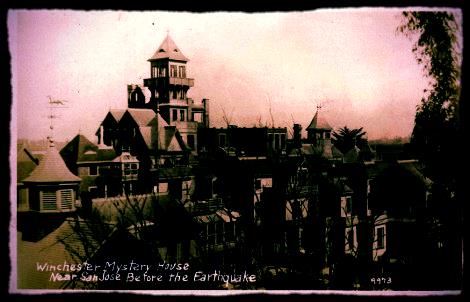
Winchester Mystery House is an extravagant maze of
Victorian craftsmanship – marvelous, baffling, and eerily eccentric, to
say the least. Tour guides must warn people not to stray from the group
or they could be lost for hours! Countless questions come to mind as you
wander through the mansion – such as, what was Mrs. Winchester thinking
when she had a staircase built that descends seven steps and then rises
eleven?
Some of the architectural oddities may have practical explanations. For
example, the Switchback Staircase, which has seven flights with forty
four steps, rises only about nine feet, since each step is just two
inches high. Mrs. Winchester arthritis was quite severe in her later
years, and the stairway may have been designed to accommodate her
disability.
The miles of twisting hallways are made even more intriguing by secret
passageways in the walls. Mrs. Winchester traveled through her house in a
roundabout fashion, supposedly to confuse any mischievous ghosts that
might be following her.
This wild and fanciful description of Mrs. Winchester’s nightly prowl to
the Séance Room appeared in The American Weekly in 1928, six years
after her death:
“When Mrs. Winchester set out for her Séance Room, it might well have
discouraged the ghost of the Indian or even of a bloodhound, to follow
her. After traversing an interminable labyrinth of rooms and hallways,
suddenly she would push a button, a panel would fly back and she would
step quickly from one apartment into another, and unless the pursuing
ghost was watchful and quick, he would lose her. Then she opened a
window in that apartment and climbed out, not into the open air, but
onto the top of a flight of steps that took her down one story only to
meet another flight that brought her right back up to the same level
again, all inside the house. This was supposed to be very discomforting
to evil spirits who are said to be naturally suspicious of traps.”
 The House Built By The Spirits.
Winchester’s Building Methods
According to legend, Mrs. Winchester enacted a nightly séance to help
with her building plans and for protection from “bad” spirits. While she
sometimes drew up simple sketches of the building ideas, there were
never any blueprints….or building inspectors! In the morning, she would
meet with John Hansen, her dutiful foreman, and go over new changes and
additions.
During the early years of construction, this resulted in some awkward
and impractical concepts such as columns being installed upside down –
though some suggest this was done deliberately to confuse the evil
spirits.
But this is how the Winchester Mystery House™ became known as “the house
built by the spirits.” John Hansen stayed with Mrs. Winchester for many
years, redoing scores of rooms, remodeling them one week and tearing
them apart the next.
It is doubtful whether John Hansen ever questioned his boss. Mrs.
Winchester may have been trying to confuse evil spirits, or simply
making mistakes, but there were no budget ceilings or deadlines to meet.
This resulted in many features being dismantled, built around, or
sealed over. Some rooms were remodeled many times. It is estimated that
500 rooms to 600 rooms were built, but because so many were redone, only
160 remain. This naturally resulted in some peculiar effects, such as
stairs that lead to the ceiling, doors that go nowhere and that open
onto walls, and chimneys that stop just short of the roof!
Furnishings
Once a room was completed, and most importantly, not targeted for
further alterations, it was adorned with some of the best furnishings
money could buy. Mrs. Winchester appreciated beauty, and she was a woman
with exquisite taste. Freight cars loaded with gold and silver plated
chandeliers, imported Tiffany art glass windows then valued up to $1,500
each, German silver and bronze inlaid doors at twice that amount, Swiss
molded bathtubs, rare precious woods like mahogany and rosewood, and
countless other items were docked onto a side track at San Jose.
Everything was then transported to the house where much of the material
was never even installed. At the time of Mrs. Winchester’s death in
1922, there were rooms full of ornate treasures still waiting to find a
niche in the massive home.
Parquet Floors
Among the most remarkable features of the house are the parquet floors.
One craftsman worked for thirty-three years doing nothing but building,
installing, and tearing up the floors! They are made of mahogany,
rosewood, teak, maple, oak and white ash, arranged in impressive
mosaics. Mrs. Winchester’s favorite bedroom, the one in which she died,
has a notably special floor. It is laid so that the sunlight streaming
through the windows appears to change the dark strips to light, and then
back again, when viewed from the opposite ends of the room.
Art Glass
Though Mrs. Winchester could be very frugal in her approach to building,
at times she was extravagant as a person could be. The mansion’s
dazzling art glass windows are a good example of her exquisite taste.
Many were made to order in Austria and imported by Tiffany’s of New
York. They are spectacularly designed, utilizing both concave and convex
glass “frames” inset with glittering “jewels.” Mrs. Winchester herself
designed the special daisy and spiderweb patterns that are embedded in
many of the window. The daisy was her favorite flower, and some believe
the spiderweb pattern had a special occult meaning for her.
Cabinets
The finest cabinetmakers toiled for years, using richly polished woods,
to create built-in chests with deep drawers and tremendous bins and
lockers. Inside were stored the rarest satins and silks;
hand-embroidered linens from China, Ireland, and the Philippines; and
bolt upon bolt of elegantly woven cloth from Persia and India. Legend
has it that Mrs. Winchester bought whole bolts of material so that
nobody else in the valley would have the same pattern.
Hall of Fires
Because of the mansion’s immense size, it contained forty-seven
fireplaces and seventeen chimneys. One rambling section in particular,
the Hall of Fires, was designed to produce as much heat as possible –
perhaps to ease Mrs. Winchester’s extreme arthritis. In addition to many
windows that let the sunlight stream through, the three adjoining rooms
have four fireplaces and three hot air registers from the coal furnace
in the basement.
The Grand Ballroom
Mrs. Winchester’s elegant Grand Ballroom is built almost entirely
without nails. It cost over $9,000 to complete at a time when an entire
house could be built for less than $1,000! The silver chandelier is from
Germany, and the walls and parquet floor are made of six hardwoods –
mahogany, teak, maple, rosewood, oak, and white ash.
The most curious element of the Grand Ballroom are the two leaded
stained glass windows, each inscribed with a quote from Shakespeare. The
first, “Wide unclasp the table of their thoughts,” is from Troilus and
Cressida (IV:5:60). The lines are spoken by Ulysses, and refer to
Cressida’s sometimes flirting nature. The second, “These same thoughts
people this little world,” is from Richard II (V:5:9). The imprisoned
Richard means that his thoughts people the small world of his
confinement. Nobody knows for certain what these lines meant to Mrs.
Winchester. While they apparently held some special meaning for Mrs.
Winchester, their significance remains a mystery today.
Ironically, the ballroom was probably never used to hold a ball.
According to one story, Mrs. Winchester once heard that a celebrated
orchestra was performing in San Francisco. She invited the musicians to
play at her home, but scheduling conflicts prevented the visit. In any
case, Mrs. Winchester sealed off the ballroom after the earthquake of
1906.
The 1906 Earthquake
If Mrs. Winchester took precautions to enlist the aid of friendly
spirits, they were nevertheless unable to protect her from the Great San
Francisco Bay Area Earthquake of 1906. The quake registered 8.3 on the
Richter scale and stretched all the way from Oregon to Los Angeles. It
severely damaged Mrs. Winchester’s home, toppling the seven-story
Observation Tower and some cupolas. She herself was badly shaken,
trapped in her favorite Daisy Bedroom near the front of the mansion. It
took servants several hours to locate her and then pry open the bedroom
door and rescue her.
Its is said that Mrs. Winchester felt the earthquake was a warning from
the spirits that she had spent too much money on the front section of
the house, which was nearing completion. After having the structural
damage repaired, she immediately ordered the front thirty rooms –
including the Daisy Bedroom, Grand Ballroom, and the beautiful front
doors – sealed up.
The heavy, ornate front doors, which had been installed just prior to
the earthquake, had only been used by three people – Mrs. Winchester and
the two carpenters who installed them.
Exterior Architecture
The outside of the mansion received nearly as much care and attention as
the inside. The cast external facade is bursting with Queen Anne
Victorian architecture feature like turrets, towers, curved walls,
cupolas, cornices, and balconies, all outlined with finely detailed
trimwork.
When viewed from different angles, the towers, some topped by ornamental
spires called finials, give the house a castlelike appearance.
A House Built For Spirits?
We may never know for sure if Mrs. Winchester built her house to
accommodate the spirits, but over the years the story has come down that
she believed her life was unavoidably affected by departed souls.
Presumably she wanted to be friendly with the “good” spirits and avoid
the “bad” spirits – and the way to be friendly with the “good” spirit,
it seemed, was to build them a nice place to visit.
According to this theory, Mrs. Winchester accommodated the friendly
spirits by giving them special attention. For example, it is said that
there were only three mirrors in the entire house at the time of Mrs.
Winchester’s death. Legend has it that spirits hate mirrors, since the
sight of their reflection causes them to vanish.
This is why Mrs. Winchester’s servants and secretary reportedly used only hand mirrors or went without.
The mansion also contained a profusion of light sources, from gas jets
and countless candles, to electric light bulbs. Supposedly spirits feel
conspicuous and humiliated by shadows, since they cannot cast their own.
Was Mrs. Winchester making a special effort to please her spirits companions?
In any case, for nearly thirty-eight years, the round-the-clock sawing,
sanding, and hammering at the Winchester Mystery House™ never ceased –
not even on weekends or holidays. It was never a rush job. Mrs.
Winchester had all the time in the world – at least, all the time needed
to maintain a steady pace. With her financial freedom, she was content
to honor whatever whims came from her imagination and from the spirits
she believed were guiding her.
Reports that the Winchester House may indeed contain a portal to the other side continue to linger, with guests and staff alike experiencing strange occurrences on an almost daily basis.
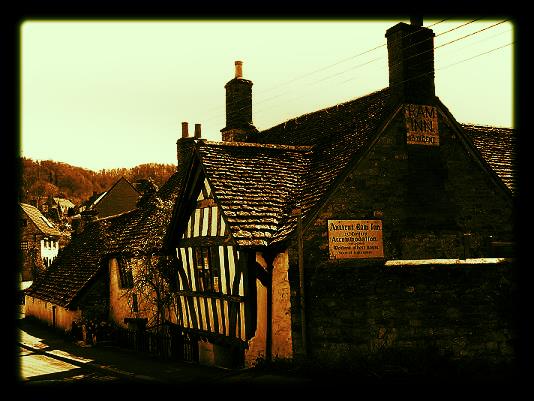
The Ancient Ram Inn can be found within the village of
Wotton-under-Edge in Gloucestershire. Many people believe that it is
one of the most haunted buildings in the UK, if not the world! The
inn is owned by John Humphries. Mr. Humphries also lives in the inn. The
inn was once owned by the St. Mary’s Church when it was first built.
Because of the reported spectres seen in the inn, it has been
investigated by various paranormal researchers. It has been featured in
various television shows, such as Most Haunted and the US series ‘Ghost
Adventures’.
Brief History
The inn was built in 1145. Priests used the inn years ago as a
keeping house for slaves and workers who helped construct the St. Mary
Church. In 1930, the inn was bought by Maurice de Bathe. Since then the
inn has become a private property and it has changed hands several
times.
The land where the inn is built is on the intersection of 2 Ley
Lines. These are places which people believe to have high spiritual
energy. When you use a map, you can trace the lines all the way through
the centre of Stonehenge. According to legend, Stonehenge has energy
which travels through the Ley Lines to feed the paranormal power found
in the Ancient Ram Inn. Furthermore, an ancient Pagan burial ground is
reported to have resided in the location over 5,000 years ago.
John Humphries bought the building in 1968 from brewers for £2,600.
He saved the building from demolition and he has made it his life’s
mission to save the structure from falling apart. He is now over 80
years old and he is the sole occupant of the house and from what people
say, a right character too.
Ghosts of Ancient Ram Inn
One popular legend surrounding the Ancient Ram Inn is that of the
witch burned at the stake. She was burned at the stake in the 1500s. It
was the prosecution of people who did not believe and practice
Christianity as sanctioned by the government. A lot of people believe
that the woman’s spirit still haunts one of the rooms of the house to
this day. It is believed that the woman took refuge in one of the rooms
of the house before she was captured and killed. Today, that room is
called “The Witch’s Room”.
It is widely believed that the redirecting of water on the Ancient
Ram property caused a portal for dark energy to open up. The owner
himself, John Humphries, can attest to the spectres which have made the
house their home. During John’s first night, he claims to have been
grabbed by the arm by a demonic force and dragged from the bed across
the room.
John Humphries has found evidence of Devil worship and ritual
sacrifice too. He discovered the skeletal remains of children just under
the staircase. Broken daggers were also found within the skeletons.
Until this day, he claims to be haunted and attacked by various entities
in the house on a regular basis. There have been many sightings of
previous owners of the inn seen residing and sitting together with the
patron’s of today’s time.
One of the most haunted rooms in the entire inn is called “The
Bishop’s Inn”. The room is found on the first floor of the house. When
the inn was still a bed and breakfast, a lot of guests would not want to
sleep in the room. Some who did sleep ended up fleeing in the middle of
the night. It is said that the ghost of a monk haunts the room on a
regular basis.
The ghost of a centurion on horseback has also been spotted. It is
said that the plumber who saw the apparition was startled out of his
wits when the apparition went straight through the wall. There is also
talk of a succubus which creeps into the beds of sleeping visitors. 
Few houses in San Diego are as historically important as the Whaley
House. In addition to being the Whaley Family home, it housed a granary,
the County Court House, San Diego's first commercial theater, various
businesses including Thomas Whaley's own general store, a ballroom, a
billiard hall, school, and polling place. Significant events, such as
the siezure of the court documents and records in 1871, and the suicide
of Violet Whaley in 1885 profoundly affected Thomas and Anna Whaley.
These events, as well as the hangings which occurred on the property
before the house was constructed, have suffused the Whaley House with an
air of mystery and added to its reputation as something more than just
California State Historic Landmark #65.
According to the Travel Channel's America's Most Haunted, the
house is the number one most haunted house in the United States. The
alleged hauntings of the Whaley House have been reported on numerous
other television programs and been written up in countless publications
and books since the house first opened as a museum in 1960. Although we
cannot state positively that the Whaley House is really haunted, the
voluminous documentation of paranormal occurances at the site makes a
compelling case. But, if there are ghosts at the Whaley House, who are
they and why are they here?
The earliest documented ghost at the Whaley House is "Yankee Jim." James
(aka Santiago) Robinson was convicted of attempted grand larceny in San
Diego in 1852, and hanged on a gallows off the back of a wagon on the
site where the house now stands. The local newspaper reported that he
"kept his feet in the wagon as long as possible, but was finally pulled
off. He swung back and forth like a pendulum until he strangled to
death." Although Thomas Whaley had been a spectator at the execution, he
did not let it dissuade him from buying the property a few years later
and building a home for his family there. According to the San Diego Union,
"soon after the couple and their children moved in, heavy footsteps
were heard moving about the house. Whaley described them as sounding as
though they were made by the boots of a large man. Finally he came to
the conclusion that these unexplained footfalls were made by Yankee Jim
Robinson." Another source states that Lillian Whaley, the Whaleys'
youngest daughter who lived in the house until 1953, "had been convinced
the ghost of "Yankee Jim" haunted the Old House." A visitor to the
museum in 1962 mentioned that "the ghost had driven her family from
their visit there more than 60 years [earlier], her mother was unnerved
by the phantom walking noise and the strange way the windows unlatched
and flew up."
Many visitors to the house have reported encountering Thomas Whaley
himself. The late June Reading, former curator of the museum, said, "We
had a little girl perhaps 5 or 6 years old who waved to a man she said
was standing in the parlor. We couldn't see him. But often children's
sensitivity is greater than an adult's." However, many adults have
reported seeing the apparition of Mr. Whaley, usually on the upper
landing. One said he was "clad in frock coat and pantaloons, the face
turned away from her, so she could not make it out. Suddenly it faded
away."
The specter of Anna Whaley has also been reported, usually in the
downstairs rooms or in the garden. In 1964, Mrs. Whaley's floating,
drifting spirit appeared to [television personality Regis] Philbin. "All
of a sudden I noticed something on the wall," Philbin reported. "There
was something filmy white, it looked like an apparition of some kind, I
got so excited I couldn't restrain myself! I flipped on the [flash]light
and nothing was there but a portrait of Anna Whaley, the long-dead
mistress of the house."
Other visitors have described seeing or sensing the presence of a woman
in the courtroom. "I see a small figure of a woman," one visitor said,
"who has a swarthy complexion. She is wearing a long full skirt,
reaching to the floor. The skirt appears to be a calico or gingham,
small print. She has a kind of cap on her head, dark hair and eyes and
she is wearing gold hoops in her pierced ears. She seems to stay in this
room, lives here, I gather." None of the Whaleys fit this description,
but the house was rented out to numerous tenants over the years. Perhaps
the mysterious woman in the courtroom was one of these.
Another presence reported by visitors and docents is that of a young
girl, who is usually found in the dining room. Psychic Sybil Leek
encountered this spirit during a visit in the 1960s. "It was a
long-haired girl," Sybil said. "She was very quick, you know, in a
longish dress. She went to the table in this room and I went to the
chair." Urban legend has it that this is the ghost of a playmate of the
Whaley children who accidentally broke her neck on a low-hanging
clothesline in the backyard, and whose name was either Annabel or Carrie
Washburn. There are no historic records of any child dying this way at
the Whaley House; nor is there record of any family named Washburn
residing in San Diego at the time. It is believed that the legend was
started by a one-time employee of the Whaley House, in an effort to add
to the house's mystique.
Even animals aren't left out of the singular occurances. A
parapsychologist reported he saw a spotted dog, like a fox terrier, that
ran down the hall with his ears flapping and into the dining room. The
dog, he said, was an apparition. When they lived in the house, the
Whaley's owned a terrier named Dolly Varden.
The Whaley House stands silently watching over San Diego Avenue as it
has done for a century and a half. Every day visitors come from around
the world to tour the historic museum. It contains so much history
within its walls, that even the non-believer will enjoy the tour. For
believers and sceptics alike, the house draws them back time and again,
in search of those elusive ghosts. As Regis Philbin once said, "You know
a lot of people pooh-pooh it because they can't see it. But there was
something going on in that house."
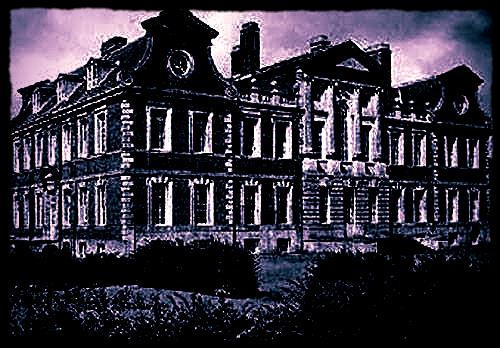
Without a doubt, the Brown Lady is the Hall’s most popular resident
ghost. The Brown Lady is thought to be that of Lady Dorothy, the wife of
Turnip Townsend and the sister of Prime Minister Robert Walpole. She is
reported to have been locked up in the residence by her better half and
it’s believed this is one of the reasons why she still haunts the
Raynham Hall staircase. A picture of the Brown Lady captured in the
1930s is one of the world’s most famous ghost photographs.
The photographers who captured the Brown Lady were Indre Shira and
Captain Provand. They were assigned by Country Life Magazine to profile
the famous Raynham Hall. The photo was later published in Country Life
Magazine. The photograph is respected among ghost pictures enthusiasts;
however, it also has its share of sceptics who label the photo a fake.
Some photo experts have claimed that it is the result of double exposure
or two images put together to form the figure of a spirit descending
the stairs.
There were so many reports that Lady Dorothy was abused and
maltreated by her husband, however, papers uncovered in the 1960s point
to the contrary. Evidence suggests that she lived a happy and fulfilling
life. She was buried in 1726; however, many people believe that she did
not die in that year and that the funeral was nothing but a farce. They
believed that she was locked up by her husband in the house.
Other spirits who are said to also live in the Hall are the Duke of
Monmouth, the caretaker of a cocker spaniel, and two ghostly children.
The old house has a long history of pain and suffering and people
believe this is one of many things which draws tortured souls to it.
This estate in St. Francisville, Louisianna., built in 1796 by General David
Bradford, is considered one of America's most haunted locales. Some say
it has witnessed as many as ten murders. Though it allegedly hosts
several ghosts, one of the most popular tales concerns a former slave
named Chloe, who, as legend goes, had her ear chopped off by her master
for eavesdropping. She allegedly sought revenge by poisoning a birthday
cake, which killed two of the slave master's daughters (their spirits
are also said to haunt the plantation). According to the story, Chloe
was hung by fellow slaves, and lingers around the plantation, her
severed ear concealed by a turban.
EASTERN STATE PENITENTIARY
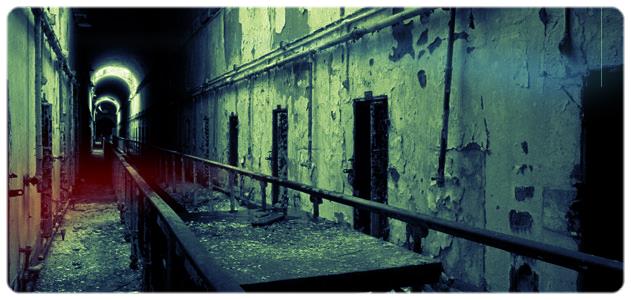
Known as being the most expensive building built in the U.S. at the time,
the Eastern State Penitentiary became a prototype in design to 300
prisons.
The facility was operated under the Pennsylvania System from 1829 to
1913. This system, used by the Quakers, was designed to force the inmates who were sent there to look inside themselves and find God. In
reality, the system which placed inmates in complete solitude, drove
many a sane man to madness.
Tough Time
Prisoners at Eastern State had a toilet, table, bunk and Bible in their
cells, in which they were locked all but one hour a day. When the
prisoners did leave their cells, a black hood would be placed over their
head so they could not see any other prisoners as they were guided
through the halls of the prison. Interaction and any form of
communication between inmates was forbidden.
Inmates lived a life in mundane solitude and would only get a glimpse of
sunlight, known as "The Eye of God" which came through a slit in the
prison ceiling. In desperate need of human interaction, prisoners would
tap on pipes or whisper through vents to each other. If caught, the
penalty was brutal.
Harsh Punishments
- The Water Bath
The inmates who broke the rules risked being dunked in a bath of
ice-cold water then hung from a wall for the night. During the winter
months, when this punishment was most popular, the water on the
inmates's skin would form into a layer of ice before morning.
- The Mad Chair
The Mad Chair was named such because it was not uncommon for an inmate
to go mad before his punishment ended. Inmates would be strapped into
the chair with leather strips, so tightly that it was impossible for
them to make the smallest of movements. They would sit for days, without
food, until the circulation in their body almost stopped from the
tightness of the straps and the lack of movement.
- Iron Gag
The most deadly punishment was known as the Iron Gag and specifically
designed for those inmates who refused to obey the no communication
policies. An iron collar was clamped onto the tongue of the inmate, and
then chained to his wrists which were strapped high behind their back.
Any movement resulted in a tearing of the tongue and severe bleeding.
Many inmates who suffered this torture died from loss of blood before
their torment ended.
- The Hole
Dug under Block #14, the hole was nothing but a pit in the ground where
incorrigible inmates would stay locked, sometimes for weeks. There was
no light, little air, and those thrown into its tortuous grip would
receive water and a slice of bread, if they got to it before the rats
and roaches.
It has been reported that the Quakers were not responsible for the
punishments the inmates were forced to endure. The extreme penitence was
something the hired staff in the prison designed and enforced.
Charles Dickens visited the prison in the 1840s and found the conditions
appalling. He described the inmates at Eastern Penn as being "buried
alive..." and wrote about the psychological torture the inmates suffered
at the hands of their captors.
Prior to its reform in 1913, the prison which was designed to house 250
inmates had over 1700 prisoners jammed into tiny makeshift cells where
there was little light and even less ventilation. Finding the conditions
of the prison unacceptable, the prison was taken over and reformed and
the Pennsylvania System was abolished. Finally, in 1971, the sprawling
monstrous prison was closed.
Ghost Stories of Eastern State Penitentiary
Since its closure visitors, employees and those researching paranormal
activity have reportedly heard unexplained eerie sounds throughout the
prison.
The Locksmith
One major paranormal episode reported occurred to a locksmith doing
restoration work in Cell Block #4. According to the tale, he was working
to remove a 140-year-old lock from the cell door when a massive force
overcame him so powerfully he was unable to move.
Some believe when he removed the key it opened a gateway to the
horrific past and offered the spirits caught behind its bars a pathway
out. The man spoke of experiencing an out-of-body state as he was drawn
toward the negative energy which burst through the cell.
Anguished faces appeared on the cell wall, hundreds of distorted
forms swirled around the cellblock and one dominating form seemed to
beckon the locksmith to him. The man's experience was so vivid, years
after he would shudder in fear when he talked about it.
Today the penitentiary is opened to the public. In a typical year, maybe
two dozen paranormal investigations take place in the cell blocks, and
according to Assistant Program Director Brett Bertolino, they almost
always find evidence of activity.
Tourists and employees have reported hearing weeping, giggling and whispering coming from inside the prison walls.
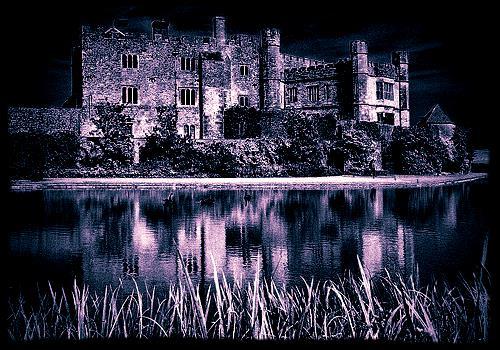
During its 900 years of existence, the Tower of London has earned the
reputation of being one of the most haunted places in the UK. Thomas A.
Becket is said to be one of the first ghosts seen in the tower. When
the Inner Curtain Wall was still in construction, Thomas seemed to be
very unhappy about it and reduced the wall to rubble with the strike of
his cross. The grandfather of Henry III was said to be the reason for
Thomas A. Beckett’s death so he built a chapel in the Tower for the
Archbishop. People believe that Beckett was pleased with the
construction of the chapel because no further interruptions were
reported after the incident with the Inner Curtain Wall.
Arbella Stuart is one of the castle’s most famous ghosts. It is said
that her ghost stays in The Queen’s House on Tower Green. According to
records, Arbella Stuart married the nephew of Lady Jane Grey, William
Seymour. The marriage was thought of as a threat because it did not
have the permission of King James I. Arbella was put under house arrest
in Lambeth while her husband William was sent to the tower. Arbella
plotted to get William released so that they could travel together to
France, however, William missed the rendezvous. Arbella set sail all
alone but she was recognised and was sent back, this time to the Tower.
William, on the other hand, made it to freedom. She stayed there until
her death in 1615 in The Queen’s House. It is believed that she was
murdered in the castle.
The most persistent of all ghosts in the Tower of London is that of
no other than Queen Anne Boleyn. She was married to King Henry VII. She
was arrested and taken to Tower Green and was beheaded on the 19th
of May 1536. Several sightings of Anne Boleyn have been reported. She
appears close to the site where she was executed and has also been seen
leading a procession down the aisle of a chapel. Several people have
reported seeing her headless body walking the Tower’s corridors.
The Bloody Tower is a place in the castle which conjures up grisly
images. There is the story of the two young princes, Edward V and his
brother Richard, who were declared illegitimate by Parliament and sent
to the tower. They were often seen playing around happily in the grounds
but suddenly vanished and were never seen again. It was assumed that
they were murdered by order of their uncle, the Duke of Gloucester. Two
skeletons, believed to be the children, were unearthed beneath a
staircase in the White Tower. The ghosts of the children are often seen
wearing nightgowns clutching each other in terror in the rooms of the
castle. They are also heard throughout the Tower.
There is also the White Lady of the massive White Tower. The White
Tower is one of the oldest and most foreboding buildings and it is the
eerie haunt of the White Lady. She was said to have stood once at a
window waving to little children at the building on the opposite side.
Her cheap perfume impregnates the air on the entrance to St. John’s
Chapel.
Guards of the Tower of London have reported having a terrible
crushing sensation upon entering the place where King Henry’s VIII
impressive suit armour is exhibited. A guard who was patrolling the
grounds have reported a sensation of someone throwing a cloak over him.
When he tried to free himself, the cloth was seized from behind and
pulled tightly around his throat by his unseen attacker.
History
The Tower of London was built by William the Conqueror in 1078. It is
a complex of multiple buildings set within two rings of walls built to
keep intruders out. Several expansions have been made by kings during
the 12th and 13th century. Although there have
been a lot of modifications and additions to the tower, the original
layout of the tower remains. The Tower of London has played a major role
in the history of England. It has been a treasury, a public records
office, an armoury, the Royal Mint’s home, and the home of the country’s
crown jewels.
The country’s history would be incomplete if the Tower of London is
not mentioned. The tower has been besieged several times. Kings and
conquerors believed that in order to control the country, the tower must
be controlled first. During the 15th century, the castle was used as a prison. However, the peak period of the castle’s use as a prison was in the 16th and 17th
centuries. Elizabeth I was one of the many prominent figures who were
held captive in the tower. The use of the tower as place for captives
popularized the term “sent to the Tower”.
Although there has been a lot of talk and a pervading belief that the
tower is a place of death and torture, only a total of seven people
were executed within the tower, a figure which is low compared to other
places. The executions were commonly held on the Notorious Hill of the
castle. In a 400-year period, 112 executions took place on Notorious
Hill.
Two men, John Taylor and Anthony Salvin, restored the castle to what
they believed was its medieval appearance. They cleared out most of the
vacant post-medieval structures. During the two World Wars, the castle
was again used as a prison and 12 men were executed for espionage. The
castle was badly damaged during Blitz in the Second World War but it was
repaired and opened to the public. Today, the castle is cared for by
the Historic Royal Palace, a charity, and protected as a World Heritage
Site. 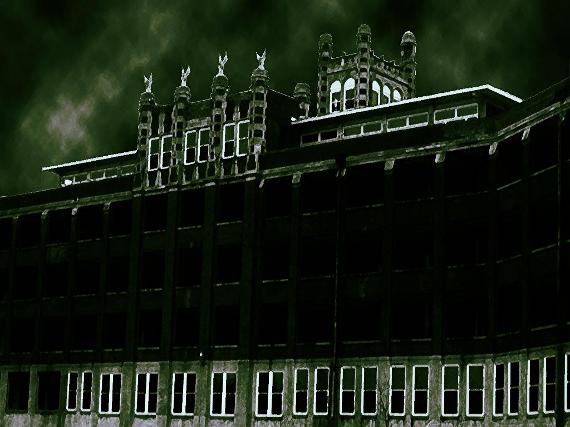
One very mysterious building that has been the subject for a great many years, of many ghost stories among many individuals is located in Waverly Hills, Kentucky. When you hear, or read about the many interesting ghost stories that involve this haunted sanitorium, it will then become one place that you will surely not want to miss the opportunity of seeing.
The Waverly Hills Sanitorium was a very large hospital that was built back in 1910, and it housed thousands of very sick patients that were suffering from having the disease of tuberculosis. There were literally hundreds of sick patients who resided here, and most of who eventually succumbed to the disease and died in the Waverly Hills hospital. In some cases, there would be patients of literally entire families, and even entire towns that would end up dead from having this tragic disease
Thousands upon thousands of tourists and other visitors have come to walk the halls and many rooms, to try and see a sighting of ghosts for themselves on one of the Waverly Hills Sanitorium tours that began many years after this haunted hospital was closed down. There are even some visitors who have said that they have actually seen a Waverly Hills ghost, they say were located on the fourth and fifth floors of the sanitorium.
One very eerie aspect of the Waverly Hills
haunted house that is known to be of huge interest to a large number of
individuals, would be that of the death tunnel that is located within
this mysterious and spooky hospital. This tunnel was built during the years of the hospitals operation, so that the workers of the hospital would have a way to be able to load the numerous bodies of victims who eventually died from having the disease of tuberculosis. The bodies would be loaded down the chute, and end up at the bottom of the hill where the hospital stood. The large number of patients
that would finally give up and succumb to their illness would be
secretly loaded into the death tunnel, and while this was happening, all
of the other patients of the hospital were totally unaware. Doctors of the Waverly House did not want the patients that were alive, to have any knowledge of the vast amount of patients who were actually dying every single day, from the disease. |
|
This is part of an episode of LivingTV's Most Haunted in which the crew are investigating The Ancient Ram Inn (featured on this page). Crew Member Stuart Torrevel is attacked by an entity.
The Ghost Adventures (Zach, Aaron and Nick) team investigate the frightening Waverly Hills Sanitorium
This a video showing a few of the many reported hauntings at Borley Rectory.
THE WINCHESTER MYSTERY HOUSE
The Ghost Adventures team investigate The Winchester Mystery House.
THE VILLISCA AXE MURDER HOUSE
The Ghost Adventures team investigate The Villisca Axe Murder House.
|