CRYPTIDS
Cryptid is such a vague term but here we use it to mean any animal that is not recognized as a species by science. Whether these creatures are new species yet to be found or demonic beasts lurking on the peripheries of our realm, we just don't know but either way there are some pretty scary sightings out there. Here are but a few.
(If you have had any experiences with Cryptids please let us know via our contact page or by email at udb@mail.com)
Hellhounds/ Phantom Black Dogs
Stories of phantom black dogs abound in Britain, almost every county has its own variant, from the Black Shuck of East Anglia to the Padfoot and Bogey Beast of Yorkshire. Phantom black dogs have been witnessed too frequently in modern times to parcel the phenomena as pure folklore and legend, but then folklore and legend often has origins in real events. There are various theories to explain the phenomena and they seem to have many common traits from sighting to sighting.
In appearance the phantoms vary from region to region, but it is not uncommon for them to be described as calf sized, with saucer eyes and a shaggy coat. Phantom dogs are not always black however, the one that is supposed to haunt the area around Cawthorpe and Haugham in Lincolnshire, is described as white, but still has saucer eyes and is as big as calf. The Cu Sith, the traditional fairy dog of Scotland is dark green in colour, with a shaggy tail up its back. Black dogs are more often than not associated with a specific location such as an old trackway or lane, this is sometimes reflected in the name of the routeway, although not every 'Black Dog Lane' has a tradition of the haunting.
There have been some attempts at classification; the folklorist Theo Brown divided the black dog phenomena into three separate types A, B and C. (A) Being a shape-shifting demon dog; (B) being a dark black dog calf sized with shaggy fur; and (C) a dog that appears in time with certain ancient festivals in specific areas of the country. Katherine Briggs, the renowned folklorist, splits these further into demon dogs, the ghosts of human beings and the ghosts of dogs in their own right.
In local traditions the black dogs sightings are seen as death portents, especially those seen in ancient churchyards in the form of the church or Kirk Grim (Kirk being the Scottish word for Church), which is thought to represent a folk memory of a sacrifice. The black dog that used to haunt Peel castle and a nearby graveyard on the Isle of Man, is one such grim, it is said to have scared a sentry to death. Other sightings from the South of England, have been related to coincidental sudden deaths. The next two accounts relate to actual deaths by a black dog over four hundred years ago, although it is likely both events were the result of ball lightning:
 A weather vane
in Bungay Market in Suffolk depicts a black dog and a flash of
lighting, it commemorates an event on Sunday the 4th of August 1577.
Between nine and ten in the morning while the parishioners of Bungay
were at church, a fearful and violent storm broke out, which caused the
sky to darken and the church to quake. Suddenly, in the midst of the
storm, a black dog appeared within church. Lit by flashes of fire, it
ran about the body of the church causing great fear and panic. It passed
between two people kneeling at prayer, killing them instantly, and
caused another man to shrivel up, severely burned, although he is said
to have survived.
A weather vane
in Bungay Market in Suffolk depicts a black dog and a flash of
lighting, it commemorates an event on Sunday the 4th of August 1577.
Between nine and ten in the morning while the parishioners of Bungay
were at church, a fearful and violent storm broke out, which caused the
sky to darken and the church to quake. Suddenly, in the midst of the
storm, a black dog appeared within church. Lit by flashes of fire, it
ran about the body of the church causing great fear and panic. It passed
between two people kneeling at prayer, killing them instantly, and
caused another man to shrivel up, severely burned, although he is said
to have survived.
About seven miles away in Blythburgh, at around the same time, another black dog (or the same phenomena) appeared in the parish church preceded by the same thunderstorm. This black dog struck three people dead and left scorch marks on the North church door, which can still be seen today.
These two examples suggest phenomena related to the weather conditions, perhaps some form of little understood ball lighting, substantiated by the fact that one person was burned, and the scorch marks on the church door. It is difficult to make any snap judgements because of the long span of time involved from the recorded events.
Other phantom dogs are more benevolent and stories exist of people being helped from tight spots. For example Augustus Hare in his book 'In My Solitary Life' recounts a common tale he heard about a man called Johnnie Greenwood, of Swancliffe. Johnnie had to ride through a wood in darkness for a mile to get to where he was going. At the entrance of the wood he was joined by a black dog, it pattered beside him until he emerged from the trees, whereupon it disappeared as quickly as it had arrived.
On his return journey through the wood, the dog joined him again on the dark woodland path, and disappeared mysteriously when he emerged. Apparently, some years later, two prisoners condemned to death confessed that they had decided to rob and murder Johnny that night in the wood, but the presence of the large black dog had stopped them.
Black dogs often seem to haunt ancient lanes, trackways, crossroads, old churchyards and prehistoric sites. Many of these places were associated with local superstitions and the uncanny, they are liminal places, where the veil between worlds was thought to be thin. The haunts of the black dogs are also features said to denote ley lines, it has been suggested that they represent some form of energy or natural phenomena moulded by the mind into an archetype of the black dog. A great deal of work has been done by earth mystery researchers to suggest that certain geophysical conditions may affect the human mind. These places were recognised by ancient man, and that is why black dogs (as some form of archetype) appear at places of ancient sanctity. This same theory has been applied to other unexplained phenomena.
Gallows sites (often crossroads) were also common black dog haunts, the black dog was often seen as the spirit of the executed criminal, such as the dog said to haunt a gallows site in Tring, Hertfordshire: An old woman was drowned for witchcraft at Tring in the year 1751. A chimney sweep was held responsible in part for the killing, and was hanged and gibbeted near to the place of the crime. A black dog came to haunt the place where the gibbet stood, and was seen by the village schoolmaster. He described it as being shaggy, as big as a Newfoundland, with long ears and a tail, eyes of flaming fire and long teeth. It is interesting to note that at first the black dog appeared as a standing flame. Flames and scorched earth being another aspect associated with sightings.
Black dogs are also seen as guardians of treasure, especially in Scotland. A black dog was said to guard treasure buried under a standing stone near Murthley in Perthshire, here we have an account of a black dog at an ancient site and as a guardian of treasure.
In summery it seems that the phenomena of phantom dogs is a complex mix of folklore, sightings, and local superstition, which has roots reaching far into the past. There are probably a myriad of different explanations for modern sightings, and a phantom black dog is a powerful archetype, incorporated into modern stories such as the 'Hound of the Baskervilles' by Arthur Conan Doyle. We hope to delve into the mystery further in the future, including some of the many folk tales associated with them.
Werewolves

Werewolves, also known as Lycanthropes and the Children of the Moon, are part of the Downworlder population. Like Vampires, werewolves are actually humans that have contracted a disease from demons which therefore resulted in their transformation and enhanced abilities, in their case, the ability to transform into wolves and have their inhuman strengths and powers.
There are two kinds of werewolves:
- the kind that are born werewolves, with werewolf parents, and
- the kind that get infected with lycanthropy through a bite
|
|
The distinctive features of the wolf are unbridled cruelty, bestial ferocity, and ravening hunger. His strength, his cunning, his speed were regarded as abnormal, almost eerie qualities, he had something of the demon, of hell. He is the mysterious harbinger of Death. (Summers 65)
[Summers, of course, is a moron.] The reputation of wolves is notorious, even in the Bible: "Behold I send you as sheep in the midst of wolves" (Matthew 10:16). Throughout a wide variety of cultures wolves are an enemy and viewed as evil [always cultures where wolves share our own lust for other animals we feel we own all rights to].
Werewolves, or wolf-men, have been fabled and
dreaded monsters in numerous cultures throughout the world for
centuries [the same ones as above, in which wolves themselves
are already demonized]. In many examples of werewolf literature,
werewolves are created by a severe sickness.
You many recognize [werewolves] by these marks: they are pale, their vision feeble, their eyes dry, tongue very dry, and the flow of saliva stopped; but they are thirsty. (Summers 39)
Werewolves were originally viewed as very sick people who no longer had control over themselves: werewolves were people acting without conscience. Many believe "that all human, indeed all animal behaviour, behaviour is aimed at obtaining a maximum of pleasure and a minimum of pain, or even asserts that the desire for pleasure and the fear of pain are the main motives of all our actions" (Eisler 23). This is true for humans in the case of severe sickness and loss of mind. The werewolf in literature is the person who acts out in such a way, the way that a wolf would act [if the denigrating stereotype of the wolf were true].
As the legend of the werewolf has evolved,
the werewolf has become more wolf-like. This evolution has brought
the idea of a physical metamorphosis from man into wolf. In original
literature and stories, the metamorphosis from man to wolf happened
through a superficial application of costume, such as using a
girdle or wearing a wolf skin (Summers 112). The horror in this
concept is not the shape, or changing of shape, of the werewolf,
but rather the uncontrollable behavior. The change is the great
horror when depicted in horror films. In current film, the metamorphosis
is often the most horrific moment of the entire picture. Physiological
changes are actually observed occurring, including bone structure,
skin texture, and emergence of fangs. Hair grows over the body,
the nose protrudes, fangs enlarge, and pointy ears emerge from
the head. The difference between the original werewolf and the
werewolf of current films is not the behavior, for it has been
relatively constant. Rather, the difference is in the physical
metamorphosis.
The characters and myths of werewolves have
long been present but to this day remain extremely vague. No
one knows exactly what the werewolf is and why it is so horrific.
Perhaps this ambiguity is due to the fact that the werewolf does
not have a solid textual incarnation, but rather occupies legend
and lore. The werewolf has never had such clear description in
the way that Mary Shelley depicted the Frankenstein Monster and
Bram Stoker defined the vampire with Dracula. Werewolves simply
are creatures possessed by a demon, very sick, or who, through
some physical way, accrue the virus that leads to the cursed
transformation.
[Wagner the Werewolf of the Victorian potboiler notwithstanding,]
there is not just one definitive werewolf.
Chupacabra
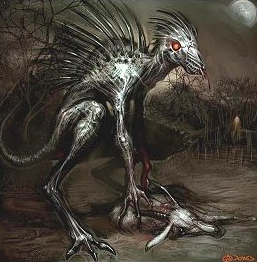
Descriptions of chupacabra vary widely, but many accounts suggest that the creature stands about four to five feet tall. It has powerful legs that allow it to leap huge distances, long claws, terrifying, glowing red eyes, and distinctive spikes down its back. While some believe that chupacabra sightings date back to the 1970s or earlier, the monsteractually first appeared in 1995 in Puerto Rico; there are no records of any vampiric chupacabras before that time.
Theories about the chupacabra's origin are as varied as the sightings themselves. The most popular explanation is that it is the product of top-secret U.S. government genetics experiments in the rainforest of Puerto Rico. Some suggest that it's an extraterrestrial being, brought to Earth on spaceships. Still others suggest that the mysterious creature is part of some sinister biological warfare program, or even the embodiment of God's wrath.
Types of chupacabras
The chupacabra had a heyday of about five years when it was widely reported in Puerto Rico, Mexico, Chile, Nicaragua, Argentina, and Florida, among other places—almost all of them in Spanish Speakinareas. After about 2000, a strange thing happened: sightings of the weird, alien, bipedal, spiky-backed chupacabra faded away. Instead, the Hispanic vampire took a very different form: a canine animal resembling hairless dogs or coyotes mostly found in Texas and the American Southwest.
 Coyotes suffering from severe cases of mange, like this one, may be the real chupacabras.
Credit: Dan Pence.

This was an important turning point because — unlike Bigfoot, the Loch Ness monster, for example — suddenly researchers had animal carcasses to scientifically examine. Dead chupacabras were subjected to DNA tests and in every instance the body has been identified as a dog, coyote, raccoon, or other common mammal — usually stricken with a parasitic infection that caused the animal to lose its fur and take on a gaunt, monstrous appearance.
Geneticists and wildlife biologists have identified all of the alleged chupacabra carcasses as those of known animals. But if none of the animals were vampiric chupacabras, what was sucking the blood out of goats, chickens, and other livestock? Though dead animals were widely reported to have been drained of blood, this is a myth. When suspected chupacabra victims have been professionally autopsied, invariably they are revealed to contain plenty of blood.
So what attacked the animals, if not the dreaded chupacabra? Sometimes the simplest answer is the correct one: ordinary animals, mostly dogs and coyotes. These animals instinctually go for a victim's neck, and their canine teeth leave puncture wounds that resemble vampire bite marks. Though many people assume that dogs and coyotes would eat or tear up the animals they attack, wildlife predation experts know this too is a myth; often they will simply bite the neck and leave it to die.

 Phylis Canion holds the head of what she is calling
a Chupacabra at her home in Cuero, Texas, Friday, Aug. 31, 2007. She
found the strange looking animal dead outside her ranch and thinks it is
responsible for killing many of her chickens. The results are in: The
ugly, big-eared animal found this summer in Cuero is not the mythical
bloodsucking chupacabra. It's just a plain old coyote.
Phylis Canion holds the head of what she is calling
a Chupacabra at her home in Cuero, Texas, Friday, Aug. 31, 2007. She
found the strange looking animal dead outside her ranch and thinks it is
responsible for killing many of her chickens. The results are in: The
ugly, big-eared animal found this summer in Cuero is not the mythical
bloodsucking chupacabra. It's just a plain old coyote.Credit: AP Photo/Eric Gay
Chupacabra: Mystery solved
Though the canine chupacabras were identified, the question remained: what happened to the original chupacabra? Why did it suddenly appear in August 1995 and vanish after only a few short years? As reported in the book "Tracking the Chupacabra: The Vampire Beast in Fact, Fiction, and Folklore," (University of New Mexico Press, 2011), it turned out that the chupacabra could be traced back to a single original eyewitness, a Puerto Rican woman named Madelyne Tolentino, whose sighting became the basis for all other accounts of the creature. She offered a detailed description of the chupacabra (bipedal, dark eyes, long limbs, and spikes along its back) that did not match any known animal — if it was real.
However, Tolentino's chupacabra was nearly identical to an alien monster in the science fiction / horror film "Species." The similarities were too great to be coincidence; she had not only recently seen the film, but stated in interviews that the movie monster "looked like the chupacabra, with spines on its back and all. ... The resemblance to the chupacabra was really impressive."
She was the first person to report seeing the chupacabra, and her report was very influential, appearing not only on the front page of the local newspaper but all over the Internet. Soon other eyewitnesses repeated and exaggerated her description, but it is clear that what she described came from a movie, not real life.
Though there's little mystery left from a scientific point of view, the goat-sucking monster will continue to be reported whether the creatures exist or not, simply because the public has come to call any strange unknown animal a "chupacabra."
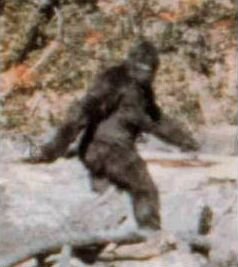
Bigfoot is described in reports as a large hairy ape-like creature, in a range of 2–3 m (6.6-9.8 ft) tall, weighing in excess of 500 pounds (230 kg), and covered in dark brown or dark reddish hair. Purported witnesses have described large eyes, a pronounced brow ridge, and a large, low-set forehead; the top of the head has been described as rounded and crested, similar to the saggital crest of the male gorilla. Bigfoot is commonly reported to have a strong, unpleasant smell by those who claim to have encountered it.The enormous footprints for which it is named have been as large as 24 inches (60 cm) long and 8 inches (20 cm) wide. While most casts have five toes — like all known apes — some casts of alleged Bigfoot tracks have had numbers ranging from two to six. Some have also contained claw marks, making it likely that a portion came from known animals such as bears, which have five toes and claws. Proponents claim that Bigfoot is omnivorous and mainly nocturnal.
History
Before 1958
Wildmen stories are found among the indigenous population of the Pacific Northwest. The legends existed prior to a single name for the creature. They differed in their details both regionally and between families in the same community. Similar stories of wildmen are found on every continent except Antarctica. Ecologist Robert Michael Pyle argues that most cultures have human-like giants in their folk history: "We have this need for some larger-than-life creature."[17]
Members of the Lummi tell tales about Ts'emekwes, the local version of Bigfoot. The stories are similar to each other in terms of the general descriptions of Ts'emekwes, but details about the creature's diet and activities differed between the stories of different families.
Some regional versions contained more nefarious creatures. The stiyaha or kwi-kwiyai were a nocturnal race that children were told not to say the names of lest the monsters hear and come to carry off a person—sometimes to be killed. In 1847, Paul Kane reported stories by the native people about skoocooms: a race of cannibalistic wild men living on the peak of Mount St. Helen. The skoocooms appear to have been regarded as supernatural, rather than natural.
Less menacing versions such as the one recorded by Reverend Elkanah Walker exist. In 1840, Walker, a Protestant missionary, recorded stories of giants among the Native Americans living in Spokane, Washington. The Indians claimed that these giants lived on and around the peaks of nearby mountains and stole salmon from the fishermen's nets.
Various local legends were compiled by J. W. Burns in a series of Canadian newspaper articles in the 1920s. Each language had its own name for the local version. Many names meant something along the lines of "wild man" or "hairy man" although other names described common actions it was said to perform (e.g. eating clams). Burns coined the term Sasquatch, which is from the Halkomelen sásq’ets, and used it in his articles to describe a hypothetical single type of creature reflected in these various stories. Burns's articles popularized both the legend and its new name, making it well known in western Canada before it gained popularity in the United States.
Frontiersman Daniel Boone reported having shot and killed "a ten-foot, hairy giant he called a Yahoo." Folktale scholar Hugh H. Trotti has argued that Boone’s account may have been the inspiration for some of the Bigfoot stories told in North America.
After 1958
In 1951, Eric Shipton had photographed what he described as a Yeti footprint. This photograph generated considerable attention and the story of the Yeti entered into popular consciousness. The notoriety of ape-men grew over the decade, culminating in 1958 when large footprints were found in Del Norte County, California by bulldozer operator Gerald Crew. Sets of large tracks appeared multiple times around a road-construction site in Bluff Creek. After not being taken seriously about what he was seeing, Crew brought in his friend, Bob Titmus, to cast the prints in plaster. The story was published in the Humboldt Times along with a photo of Crew holding one of the casts.
Locals had been calling the unseen track-maker "Big Foot" since the late summer, which Humboldt Times columnist Andrew Genzoli shortened to "Bigfoot" in his article. Bigfoot gained international attention when the story was picked up by the Associated Press Following the death of Ray Wallace – a local logger – his family attributed the creation of the footprints to him.The wife of L.W. “Scoop” Beal, the editor of the Humboldt Standard, which later combined with the Humboldt Times, in which Genzoli's story had appeared, has stated that her husband was in on the hoax with Wallace.
1958 was a watershed year not just for the Bigfoot story itself but also for the culture that surrounds it. The first Bigfoot hunters appeared following the discovery of footprints at Bluff Creek, California. Within a year, Tom Slick, who had funded searches for Yeti in the Himalayas earlier in the decade, organized searches for Bigfoot in the area around Bluff Creek.
As Bigfoot has become better known and a phenomenon in cultural society, sightings have spread throughout North America. In addition to the Pacific Northwest, the Great Lakes Region and the Southeastern United States have had many reports of Bigfoot sightings.
Prominent reported sightings

About a third of all reports of Bigfoot sightings are concentrated in the Pacific Northwest, with most of the remaining reports spread throughout the rest of North America.Some Bigfoot advocates, such as John Willison Green, have postulated that Bigfoot is a worldwide phenomenon.The most notable reports include:
- 1924: Prospector Albert Ostman claimed to have been abducted by Sasquatch and held captive by the creatures in British Columbia.
- 1924: Fred Beck claimed that he and four other miners were attacked one night in July 1924, by several "apemen" throwing rocks at their cabin in an area later called Ape Canyon - Washington. Beck said the miners shot and possibly killed at least one of the creatures, precipitating an attack on their cabin, during which the creatures bombarded the cabin with rocks and tried to break in. The supposed incident was widely reported at the time. Beck wrote a book about the alleged event in 1967, in which he argued that the creatures were mystical beings from another dimension, claiming that he had experienced psychic premonitions and visions his entire life of which the apemen were only one component. Speliologist William Halliday argued in 1983 that the story arose from an incident in which hikers from a nearby camp had thrown rocks into the canyon.There are also local rumors that pranksters harassed the men and planted faked footprints.
- 1941: Jeannie Chapman and her children said they had escaped their home when a 7.5 feet (2.3 m) tall Sasquatch approached their residence in Ruby Creek, British Columbia.
- 1958: Bulldozer operator Jerry Crew took to a newspaper office a cast of one of the enormous footprints he and other workers had seen at an isolated work site at Bluff Creek, California. The crew was overseen by Wilbur L. Wallace, brother Raymond L. Wallace. After Ray Wallace's death, his children came forward with a pair of 16-inch (41 cm) wooden feet, which they said their father had used to fake the Bigfoot tracks in 1958. Wallace is poorly regarded by many Bigfoot proponents. John Napier wrote, "I do not feel impressed with Mr. Wallace's story" regarding having over 15,000 feet (4,600 m) of film showing Bigfoot.
- 1967: Roger Patterson and Robert Gimlin reported that on October 20 they had captured a purported Sasquatch on film at Bluff Creek, California. This came to be known as the Patterson Gimlin Film. Many years later, Bob Heironimus, an acquaintance of Patterson's, said that he had worn an ape costume for the making of the film. However, Patterson and Gimlin claimed that they sought various experts to examine the film. Patterson claimed to have screened the film for unnamed technicians "in the special effects department at Universal Studios in Hollywood ... Their conclusion was: 'We could try (faking it), but we would have to create a completely new system of artificial muscles and find an actor who could be trained to walk like that. It might be done, but we would have to say that it would be almost impossible.'
- 2007: On September 16, 2007, hunter Rick Jacobs captured an image of a supposed Sasquatch by using an automatically triggered camera attached to a tree, prompting a spokesperson for the Pennsylvania Game Commision to say that it was probably an image of "a bear with a severe case of mange." The photo was taken near the town of Ridgeway Pennsylvania, in the Allegheny National Forest.
Proposed explanations for sightings
Various types of creatures have been suggested to explain both the sightings and what type of creature Bigfoot would be if it existed. The scientific community typically attributes sightings to either hoaxes or misidentification of known animals and their tracks. While cryptozoologists generally explain Bigfoot as an unknown ape, some believers in Bigfoot attribute the phenomenon to UFo's or other paranormal causes.
Most tellers of the legend of the Jersey Devil trace the devil back to Deborah Smith
who emigrated from England in the 1700s to marry a
Mr. Leeds. The Leeds family lived in the area of the NJ Pine Barrens
(Leeds Point, Galloway Township, Atlantic County). Mrs. Leeds
ha d given birth to 12 children and was about to give birth to her
13th. The story goes that Mrs. Leeds invoked the devil during a
very difficult and painful labor and that when the baby was born, it
either immediately, or very soon afterwards, (depending on the
version of the story), grew into a full-grown devil and escaped from
the house.
d given birth to 12 children and was about to give birth to her
13th. The story goes that Mrs. Leeds invoked the devil during a
very difficult and painful labor and that when the baby was born, it
either immediately, or very soon afterwards, (depending on the
version of the story), grew into a full-grown devil and escaped from
the house.
Another version of the story says it was when Mrs. Leeds found out she was pregnant with her 13th, that she said that if she were to have one more child, "may it be a devil".
Another version is that the child/devil was the result of a family curse.
Another version is that Mrs. Leeds, who was a Quaker, had refused to be converted from the Quaker faith and that the clergyman who had been trying to convert her was so angry that he told her that her next child would be an offspring of Satan.
Another version is that the child was born a monster and that Mrs. Leeds cared for the child until her death. In this version the child/devil "flew off" into the swamps after Mrs. Leeds' death.
People in the 1700s still believed in witchcraft and many people of the period felt a deformed child was a child of the devil or that the deformity was a sign that the child had been cursed by God.
It may be that indeed Mrs. Leeds gave birth to a child with a birth defect
and given the superstitions of the period, the legend of the Jersey Devil was born.
In any event there do not seem to be any subsequent reported encounters with the Jersey Devil in which he/it actually harmed anyone.
In the last 200 years or so, there have been a number of "sightings" and the hearing of eerie noises/wails in the forests which have been attributed to the Jersey Devil, but since these accounts are, in the main, generic descriptions, one is somewhat drawn to the conclusion that any number of "weird" things in southern Jersey are attributed to the Jersey Devil as a matter of course.
Over the years the Jersey Devil has been called by a number of names, "Hoodle-Doodle Bird", "Wozzle Bug" and the "Leeds Devil".
This is all not to say that people do not believe in the Jersey Devil. Many over the year have believed and reported sightings of the creature.
Sightings included one in 1870 by a Long Beach fisherman who said he saw the Jersey Devil serenading a mermaid.
The best known sightings however were in January 1909 when Councilman E.P. Weeden of Trenton claimed to have been awoken by flapping wings outside his bedroom window. The Councilman said he found cloven footprints in the snow and several other instances of similar footprints were reported in Trenton at the time. Hundreds, if not thousands, of other people also claimed to have seen the Devil within a week or so of the Councilman's "sighting" and news of the multiple sightings were reported in local papers. The January 1909 sightings were not limited to New Jersey...there were reported sightings across the river in Pennsylvania and some sightings in Delaware as well.
In 1978 two teenage boys were ice-skating near Chatsworth in the Barrens and smelled an odor like "dead fish" and saw two red eyes staring at them. They didn't stay around to investigate, but claimed they had encountered the Jersey Devil.
A number of people have claimed, not to have seen the Devil, but to have heard him, rampaging through woods, or emitting blood-curdling cries.
People have found "strange" tracks and attributed them to the Jersey Devil. One instance of such tracks was reported, (along with loud shrieks), near May's Landing in 1960. Also in 1960, merchants in Camden offered a $10,000 reward for the capture of the Jersey Devil. They said they would build a private zoo to display the creature if anyone could capture it. The reward is unclaimed.
